

Injectable Drug Delivery Devices Market to reach USD 1,665.30 Billion by 2035 at 7.50% CAGR
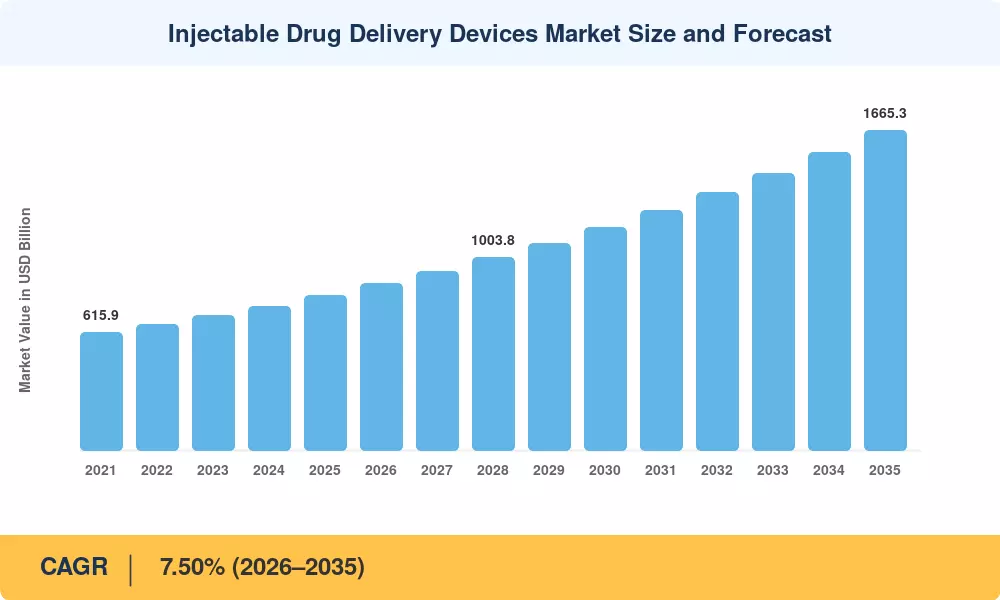
Injectable Drug Delivery Devices Market Size
Injectable Drug Delivery Devices Market to Surge from USD 868.60 Billion in 2026 to USD 1,665.30 Billion by 2035- By Expanding Biologics and Biosimilar Pipeline
NY, CA, UNITED STATES, July 21, 2026 /EINPresswire.com/ -- As per Market Research Future, the global Injectable Drug Delivery Devices Market size to reach USD 1,665.30 Billion by 2035 from USD 868.60 Billion in 2026, at a CAGR of 7.50% during the forecast period 2026––2035. The market base was estimated at USD 808.00 Billion in 2025.The 7.50% CAGR——anchored by structural biologics demand rather than discretionary healthcare spending——is driven by three converging forces: an unprecedented biologics and biosimilar pipeline that requires reliable parenteral delivery platforms, a decisive global shift toward home-based self-administration that transfers complex treatment procedures from traditional hospital settings to patient homes, and rising chronic-disease prevalence including diabetes and oncology indications that creates a highly stable long-term volume demand baseline.
National governments and multilateral health organizations are amplifying this momentum. The World Health Organization reports that global adult diabetes cases reached 830 million individuals, with severe escalations in chronic cardiovascular diseases, autoimmune conditions, and oncology cases expanding the total population requiring recurring therapies.
Request A Free Sample:
https://www.marketresearchfuture.com/sample_request/1211
Key Market Trends & Growth Drivers
Expanding Biologics and Biosimilar Pipeline
The US Food and Drug Administration confirmed that novel biological treatments reached eighteen approvals during recent annual tracking cycles. Because large molecule biologics cannot be administered orally, these complex therapies require reliable parenteral hardware. This steady regulatory influx directly accelerates manufacturing demand, establishing a durable volume driver for the global Injectable Drug Delivery Devices Market.
National industrial initiatives, including China’s 14th Five-Year Plan for drug safety and high-quality development, focus intensively on elevating domestic manufacturing capacity. Public funding targets localized biomedical tech to accelerate product evaluations while lowering baseline import dependency.
Shift to Home-Based Self-Administration
The World Health Organization places a strong emphasis on decentralized healthcare standards to lessen institutional constraints and increase treatment access worldwide. Intuitive medical device designs are encouraged when complicated treatment procedures are transferred from traditional hospital settings to home settings.
The trend of patient self-administration causes engineering objectives to shift in favor of safety, which propels ongoing innovation in the global Injectable Drug Delivery Devices Market. Canada’s national home-infusion guidelines, updated in 2024, are accelerating device adoption outside hospital settings. The UK’s NHS Long-Term Plan explicitly targets a 25% shift of injectable-biologic administration from infusion suites to patient homes by 2028, generating sustained demand across the Injectable Drug Delivery Devices Market in that country.
Rising Chronic-Disease Prevalence
The World Health Organization reports that global adult diabetes cases reached 830 million individuals. Severe escalations in chronic cardiovascular diseases, autoimmune conditions, and oncology cases expand the total population requiring recurring therapies. This growing public health burden creates a highly stable long-term volume demand baseline throughout the global Injectable Drug Delivery Devices Market.
The global insulin-dependent population exceeds 75 million, and the rapid adoption of GLP-1 agonists for obesity management sustains the diabetes therapeutic segment as the single largest driver. Immune checkpoint inhibitors extending median overall survival from 12 months to 24+ months in metastatic NSCLC create a larger prevalent population requiring sustained injectable therapy.
AI-Enabled Smart Injectors and Digital Therapeutics Integration
The World Health Organization’s global digital health strategy actively promotes incorporating mobile platforms and interoperable software into standard clinical workflows. Transitioning from simple mechanical devices toward connected injection platforms allows for continuous therapeutic oversight.
This technical shift converts traditional delivery hardware into sophisticated remote monitoring tools, reshaping long-term care management frameworks worldwide. Machine-learning models that integrate genomic, proteomic, and imaging biomarkers can recommend optimal device selection for individual patients. Start-ups have raised over USD 800 million in venture funding for connected-device and adherence-platform technologies since 2023.
Sustainable Device Design and Circular Manufacturing
The United Nations Development Programme prioritizes transitioning standard health infrastructure toward circular economy solutions by eliminating waste throughout entire production lines.
Because up to 80% of a product’s environmental impact is determined directly during the early design phase, engineering reusable injection mechanisms and recyclable polymers allows medical suppliers to capture conscious public procurement pipelines. The World Health Organization reports that up to 85% of total generated healthcare waste is non-hazardous, highlighting a massive structural opportunity to recover uninfected plastic resources. Tightening global regulations mandate a serious reduction in single-use medical waste streams, driving intense research into bio-based polymers and circular supply chains globally.
Ask for Customization:
https://www.marketresearchfuture.com/ask_for_customize/1211
Market Segment Insights
BY DEVICE TYPE
Conventional Drug Delivery Devices: Dominant segment with ~38.50% revenue share in 2024. Reflecting entrenched hospital procurement contracts and broad therapeutic applicability. Standard vial-and-syringe protocols in hospital settings anchor institutional formularies globally due to low cost and decades of clinical evidence. Hospital procurement teams treat conventional devices as default first-line agents, and broad pricing has enabled adoption even in cost-sensitive emerging markets.
Advanced Drug Delivery Devices: Fastest-growing device segment at 12.70% CAGR (2026––2035). Driven by wearable on-body platforms and connected delivery systems. Wearable on-body systems capable of delivering 3–10 mL doses subcutaneously over 15–45 minutes are attracting particular investment, especially for oncology and immunology biologics that require high-concentration formulations. On-body wearable delivery devices, sensor-embedded smart platforms, and polymer-based containers are replacing glass barrel cartridges and manual syringes.
BY THERAPEUTIC APPLICATION
Diabetes: Dominant therapeutic application with ~33.50% revenue share in 2024. Sustained by insulin-delivery innovation and the rapid adoption of GLP-1 agonists for obesity management. The global insulin-dependent population exceeding 75 million makes diabetes the single largest therapeutic driver for the Injectable Drug Delivery Devices Market.
Oncology: Fastest-growing therapeutic segment at 12.40% CAGR (2026––2035). Reflecting subcutaneous monoclonal-antibody reformulations gaining traction. The US Food and Drug Administration recently accelerated the systemic rollout of multiple subcutaneous formulations for major oncology indications, including blockbusters like pembrolizumab and atezolizumab. Transitioning these life-saving complex biological treatments from traditional intravenous infusions to rapid, low-chair-time injections creates a substantial design pipeline for purpose-built, high-volume delivery devices globally.
Autoimmune Disorders: USD 112.70 Billion in 2025. TNF-inhibitor and IL-inhibitor self-administration sustain demand.
Other Therapeutic Areas: Growing segment at 6.80% CAGR (2026––2035). Rare diseases, hormonal therapies and vaccines represent incremental demand.
BY USABILITY
Disposable Injectors: Dominant segment with ~52.10% revenue share in 2024. Single-use safety and infection control drive hospital procurement. Hospital infection-control mandates and patient safety regulations that discourage device reuse sustain this segment.
Reusable Injectors: Fastest-growing usability segment at 7.90% CAGR (2026––2035). Cost efficiency in chronic-therapy settings drives demand. Reusable platforms are gaining traction in chronic-disease segments where patients inject daily or weekly, and the per-dose economics of a durable device body with disposable cartridges become compelling over treatment lifecycles spanning years.
BY ROUTE OF ADMINISTRATION
Subcutaneous: Dominant route with ~41.50% revenue share in 2024. Self-administration compatibility drives demand. Subcutaneous delivery aligns most directly with the home-administration trend——patients can self-inject into subcutaneous tissue with minimal training.
Intravenous: Fastest-growing route segment at 9.50% CAGR (2026––2035). Acute-care and infusion-center demand sustains growth. Specialty infusion centers proliferate and hospital outpatient departments adopt programmable infusion devices with closed-loop dosing algorithms.
Intramuscular: USD 135.40 Billion in 2025. Vaccine delivery and depot formulations sustain demand.
Other Routes: Growing segment at 4.90% CAGR (2026––2035). Intrathecal, intraocular, and intra-articular delivery represent niche applications.
BY END USER
Hospitals & Ambulatory Surgical Centres: Largest segment with ~48.30% share in 2024. High-acuity parenteral therapies dominate volume. Hospitals remain the primary delivery site for complex injectable therapies due to specialized infrastructure, radiation safety requirements, and nuclear pharmacy licensing.
Read Detailed Insights:
https://www.marketresearchfuture.com/reports/injectable-drug-delivery-devices-market-1211
Regional Outlook
North America – Dominant Market (~45.80% Share, 2024)
The United States generates approximately 72.50% of North American Injectable Drug Delivery Devices Market revenue, driven by the largest biologics formulary globally, commercial insurance coverage of advanced delivery devices, and broad reimbursement for self-administration channels——a single policy ecosystem that converted a hospital-centric market into one with a structural home-care tail. CMS reimbursement for connected devices under the hospital outpatient prospective payment system has driven adoption in academic medical centers, while community oncology networks increasingly prescribe subcutaneous treatment options to manage infusion-center capacity. The US dominates through a combination of high per-patient spending, robust payer coverage, and rapid connected-device adoption.
Canada contributes through provincial home-care program expansion at 7.80% CAGR, while Mexico is growing at steady pace on COFEPRIS regulatory modernization at USD 18.30 Billion in 2025. North America’s leadership rests on reimbursement depth and the structural advanced-device segment created by expanded FDA combination-product guidance and value-based contracting.
Europe – Second Largest (USD 209.60 Billion, 2025)
Europe’s Injectable Drug Delivery Devices Market reflects divergent national strategies——Germany leads regionally with a strong med-tech manufacturing base, contributing 23.40% of regional share, while the UK historically used selective hospital targeting before broadening coverage through NHS at-home biologics programs at 7.20% CAGR. France contributes ~18.5% of regional share through centralized hospital procurement. Italy contributes 6.90% CAGR on biosimilar-driven cost optimization. Spain is growing at steady pace on growing diabetes prevalence, holding 10.50% of regional share.
Harmonization pressure from the EU Medical Device Regulation (MDR) transition is gradually narrowing these differences, lifting baseline demand across the region. The European Commission’s Pharmaceutical Strategy mandates equitable access to medical devices, including injectable delivery systems across all member states. The Nordic countries hold ~7.4% of regional share on digital-health integration at USD 14.60 Billion. Russia contributes 7.40% CAGR on import-substitution incentives. Centralized health technology assessment bodies——NICE, G-BA, and HAS——have progressively widened reimbursement for advanced delivery devices across therapeutic areas.
Asia-Pacific – Fastest-Growing Region (10.10% CAGR, 2026––2035)
Asia-Pacific is the engine of the Injectable Drug Delivery Devices Market. China holds the largest regional share with ~35.20% of regional revenue, driven by the 14th Five-Year Plan for biopharmaceutical localization——instantly elevating domestic manufacturing capacity. India is growing at 11.30% CAGR on the back of “Make in India” device manufacturing policy. Japan contributes USD 26.40 Billion through NHI pricing for advanced device standards at steady pace. South Korea is growing at 9.80% CAGR on biosimilar export platform growth.
ASEAN economies hold ~14.60% of regional share on expanding immunization infrastructure. The rest of Asia-Pacific is growing at steady pace on rising healthcare access at USD 8.70 Billion. The region’s combined contribution anchors the global volume base for injectable delivery device demand. Asia-Pacific represents the highest-growth opportunity, driven by a confluence of rising chronic disease burden, government investment in domestic manufacturing, and expanding biosimilar export capabilities. China’s NMPA expedited-review pathway for combination products is expected to shorten approval timelines by up to 30%, further stimulating device investment.
Middle East & Africa – Emerging Opportunity (8.20% CAGR, 2026––2035)
The Middle East & Africa is bifurcated between well-funded Gulf states and resource-constrained Sub-Saharan nations. Saudi Arabia leads the region with Vision 2030 healthcare investment at 9.10% CAGR, contributing ~28.50% of regional share——NEOM health cluster and the UAE’s Cleveland Clinic and Mayo Clinic affiliations have created pockets of excellence for advanced injectable delivery. The UAE holds 28.50% of regional share on medical-tourism infrastructure. South Africa contributes USD 4.80 Billion on public-sector HIV/TB treatment programs.
Egypt is growing at 8.60% CAGR on population-driven pharmaceutical demand. NGO-supported oncology access programs underpin demand across the rest of the region. Diagnostic infrastructure gaps in LMICs remain a restraint——cold-chain logistics complexity for biologics and needlestick injury concerns lead to treatment discontinuation and physician reluctance to initiate advanced delivery regimens, indirectly narrowing the Injectable Drug Delivery Devices Market addressable population.
Competitive Landscape and Recent Developments
The Injectable Drug Delivery Devices Market displays medium concentration, with the top five companies holding an estimated 35–42% combined revenue share. The Herfindahl-Hirschman Index sits in the 800–1,200 range, reflecting a mix of multinational medical device leaders and specialized delivery platform developers. Barriers to entry are rising as platform incumbents secure long-term supply agreements with top-20 pharmaceutical sponsors and invest in proprietary polymer formulations and connected-device software stacks.
The competitive landscape is stratified between conventional injection device manufacturers serving global hospital markets, advanced wearable and connected platform specialists capturing high-value tenders, and contract development manufacturing organizations consolidating the device-drug co-development segment.
KEY COMPANIES AND RECENT MILESTONES
Becton, Dickinson and Company (BD) (2024––2025): Maintains leadership with the broadest portfolio across acute and chronic segments, including safety syringes, self-injection systems, and IV catheters, commanding ~8–12% of global Injectable Drug Delivery Devices Market revenue. Broadest portfolio across acute and chronic segments offsets price compression in competitive markets.
Baxter International Inc. (2024––2025): IV delivery systems and premixed drug containers reinforce the hospital-centric infusion leadership positioning, holding ~6–9% of global revenue. The company benefits from the structural hospital tail created by expanded acute-care infrastructure investment.
Gerresheimer AG (2024––2025): Glass and polymer syringes, cartridges and vials reinforce the primary packaging specialist with European manufacturing depth positioning, holding ~5–8% of global revenue.
Terumo Corporation (2024––2025): Safety-engineered needles and infusion sets reinforce the strong Japan and APAC channel presence positioning, holding ~5–7% of global revenue.
West Pharmaceutical Services (2024––2025): Elastomer components, self-injection platforms, and containment systems reinforce the device-component partner to top biologics sponsors positioning, holding ~4–7% of global revenue.
Future Outlook: 2026––2035
By 2030, precision connected-device theranostics will become the operating system of injectable drug delivery management. The convergence of companion diagnostics and targeted delivery platforms will reshape the Injectable Drug Delivery Devices Market through the late 2020s. By 2030, an estimated 40% of newly diagnosed metastatic patients will undergo connected-device staging followed by matched drug-device therapy, creating a diagnostic-therapeutic revenue loop.
The FDA’s updated combination-product guidance ensures domestic supply scales alongside clinical demand. Machine-learning models that integrate genomic, proteomic, and imaging biomarkers can recommend optimal device selection for individual patients.
More Related Research Insights:
https://www.marketresearchfuture.com/reports/myelodysplastic-syndrome-treatment-market-43663
https://www.marketresearchfuture.com/reports/myopia-presbyopia-treatment-market-42555
https://www.marketresearchfuture.com/reports/nasal-pillow-mask-market-34016
https://www.marketresearchfuture.com/reports/nephrology-stents-catheter-market-43137
https://www.marketresearchfuture.com/reports/nephrology-stents-catheters-market-42567
https://www.marketresearchfuture.com/reports/neuroprotective-agent-market-42163
https://www.marketresearchfuture.com/reports/neurothrombectomy-device-market-42166
https://www.marketresearchfuture.com/reports/non-invasive-ventilator-market-42184
https://www.marketresearchfuture.com/reports/nursing-robot-market-43134
https://www.marketresearchfuture.com/reports/ocular-trauma-device-market-33957
Larry Wilson
WantStats Research And Media Pvt. Ltd.
+1 855-661-4441
email us here
Visit us on social media:
LinkedIn
Facebook
YouTube
X
Legal Disclaimer:
EIN Presswire provides this news content "as is" without warranty of any kind. We do not accept any responsibility or liability for the accuracy, content, images, videos, licenses, completeness, legality, or reliability of the information contained in this article. If you have any complaints or copyright issues related to this article, kindly contact the author above.
